| Subsystems - Air intake | ||
 ______________________________________________________________________ ______________________________________________________________________ |
||
| Combustion |
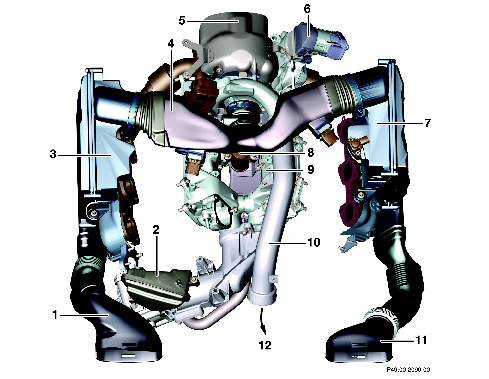
Air ducting
Overall, engine 642 has an extremely compact construction in which all the air ducting components, including the air filter system, are accommodated on the engine itself.
Intake Port Shutoff
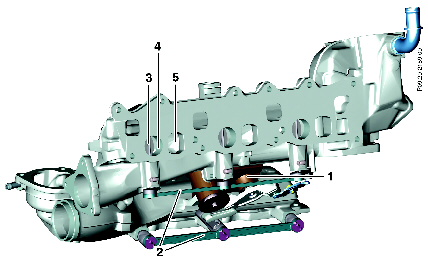
The intake manifold contains two intake ports for each cylinder:
The charge intake ports can be closed by means of flaps. They are held in the open position by spring force. The position of the flaps is determined according to the performance map stored in the CDI control module. The CDI control module reads signals from the following components:
- Mass air flow sensor
- Charge pressure sensor
- Charge air temperature sensor
- Pressure sensor downstream of air filter
- Accelerator pedal sensor
- Crankshaft Hall sensor
The CDI control module actuates the intake port shutoff motor accordingly with a pulse width modulated signal. This then operates the flaps through linkage. In the lower engine speed and load ranges, all the charge intake ports are closed by the
flaps. The entire air mass enters the combustion chamber via the swirl intake ports only. The resulting high turbulence of the air produces a more effective mixing of the fuel with the air and thus improves combustion as well as reducing the amount of soot particles in the exhaust gas. As the engine speed and load increase, the charge intake ports are gradually opened to provide the best possible relationship between air turbulence and air mass for each phase of engine operation.